Every Trek fan knows the rule. Gold means you’re in charge, blue means you’re smart, and red means you should update your will. However, Star Trek uniform colors are way messier than that. Kirk’s “gold” shirt wasn’t even gold. Then Star Trek: The Next Generation flipped red and gold without explaining why. Meanwhile, the movies tossed out the color code altogether for a while. So grab your tricorder, because we’re decoding Starfleet uniform colors from Star Trek: The Original Series to Strange New Worlds.
Table of Contents
- What Do Star Trek Uniform Colors Mean?
- The Original Series Color Code
- Kirk’s Gold Shirt Was Actually Green
- The Red Shirt Curse: Myth or Math?
- The Movie Era: Pajamas and Red Sweaters
- Why TNG Swapped Red and Gold
- DS9, Voyager, and the Gray Shoulder Era
- Enterprise, Discovery, and Strange New Worlds
- Star Trek Uniform Colors by Era (Cheat Sheet)
- FAQ
What Do Star Trek Uniform Colors Mean?
Since the very first episode of Star Trek, one thing has stayed constant. Every Starfleet uniform uses colors that show the wearer’s division. Think of it as a walking, talking, color-coded org chart in space. Star Trek uniform colors split the crew into three main divisions. First, there’s Command. These are the ranking officers who run starships and space stations. Next comes Operations, which covers engineering, security, and support. Finally, there’s Sciences, which includes exploration, medical, and mental health.
Of course, these Star Trek uniform colors look great on screen. However, they also serve a real purpose. The colors let viewers quickly identify each person’s role. Whether it’s a starship captain or a red-shirted security officer, you can figure it out in seconds. In other words, the costume department did the exposition so the script didn’t have to.
The Next Generation added another twist by putting rank pips or bars on the collar. As a result, you could read a character’s job and pay grade at a glance. Granted, the specific Starfleet uniform colors have shuffled around over the decades. Still, the three-division system has survived nearly 60 years of redesigns, reboots, and questionable fabric choices. That’s why knowing what Star Trek uniform colors mean makes every era easier to follow.
The Original Series Color Code

It was costume designer William Ware Theiss who first suggested color-coding the crew by department. Back in 1966, color TV was still a shiny new toy. So bold Star Trek uniform colors were a smart way to show it off. Theiss settled on three colors, and each one meant something specific.
First, gold was for the command crew, like Kirk and Sulu. Interestingly, Spock briefly wore gold in the second pilot. That was probably because of his dual role as the ship’s executive officer. Second, blue was for science and medical, like Spock and McCoy. Third, red represented engineering, security, and support. Think Scotty, Uhura, and that doomed fourth member of the away team who gets turned to sand.
Meanwhile, the uniforms themselves were made of velour. Men wore colored tunics with dark pants and boots. Women usually wore a uniform dress with black tights and boots. Rank appeared as gold braid on the sleeve cuffs, and Kirk wore two stripes.
These original Star Trek uniform colors became the template for everything that followed. Even when later shows changed the cut, fabric, or meaning, fans still judge every redesign against this classic lineup. Ultimately, the TOS Starfleet uniform colors are the ones you still see on Halloween costumes 60 years later.
Kirk’s Gold Shirt Was Actually Green

Here’s where Star Trek uniform colors get weird. Kirk’s iconic gold shirt wasn’t actually gold. The command tunics were made from a chartreuse-green velour. However, under hot studio lights and 1960s film stock, they photographed as golden yellow. Theiss himself later insisted the command shirts were definitely green in person.
So why do some of Kirk’s uniforms look green on screen? The answer is fabric. Kirk’s alternate wraparound tunic and the command dress uniforms used a different material. That fabric reacted differently to the lights, so its true green came through. That’s why Kirk seems to bounce between gold and green in episodes like “The Trouble with Tribbles.”
Eventually, the franchise just rolled with the gold. Star Trek: Deep Space Nine confirmed gold as the TOS command color in “Trials and Tribble-ations.” In other words, a lighting quirk became canon. Honestly, that might be the most Star Trek thing ever.
Decades later, the green finally got its revenge. Star Trek: Strange New Worlds brought back the green wraparound as an official alternate uniform for Captain Pike. He wears it at formal events, like crew dinners and diplomatic visits. As a result, the classic Starfleet uniform colors debate now has two right answers. Kirk’s shirt is gold on screen, green in real life, and both in canon.
The Red Shirt Curse: Myth or Math?
No discussion of Star Trek uniform colors is complete without the dreaded redshirt. If you wore red and beamed down with Kirk, you probably weren’t beaming back up. At least, that’s the legend. But does the math actually back it up?
At first, the raw numbers look bad. Statistician Matthew Barsalou counted 55 deaths in the original series. Of those, 24 wore red, nine wore gold, and seven wore blue. Another 15 died in colors nobody could identify. So yes, red shirts died more than anyone else.
However, there’s a catch. About 239 of the Enterprise’s 430 crew members wore red. Therefore, only around 10% of all red shirts actually died. Mathematician James Grime ran similar numbers and found gold shirts died at roughly 18%. In other words, command was statistically the riskier color.
The real killer wasn’t the color. It was the job. Security officers numbered just 90, yet they made up 18 of the 24 redshirt deaths. That’s a 20% fatality rate. Meanwhile, red-shirted engineers had survival odds close to the blue shirts.
So the lesson from Star Trek uniform colors is simple. Red is fine. Just don’t join security. And never, ever be the new guy on the away team.
The Movie Era: Pajamas and Red Sweaters

After TOS ended, Starfleet uniform colors went through a full-blown identity crisis. For Star Trek: The Motion Picture, designer Robert Fletcher ditched the bright tunics. Instead, the crew wore baggy, pajama-like uniforms in pale blue, beige, and gray. Honestly, they looked like hospital scrubs from the future.
Fletcher also expanded the color code from three divisions to six. Departments now showed up as a small circle of color behind the Starfleet delta. White meant command, orange meant science, and green meant medical. Meanwhile, red was engineering, gold was operations, and silver marked security. It was clever, but you needed binoculars to spot it.
Then Star Trek II: The Wrath of Khan changed everything again in 1982. Director Nicholas Meyer wanted a more militarized, naval look. So Fletcher designed the famous maroon jackets that everyone wore. Kirk wore red. Spock wore red. Basically, the whole crew wore red, which is terrifying given those redshirt stats.
In this era, Star Trek uniform colors moved to the turtleneck. White meant command, gray meant science, and green meant medical. These jackets lasted through Star Trek VI: The Undiscovered Country. In-universe, they stayed standard into the 2350s. Plenty of fans still call them the best Starfleet uniforms ever made.
Why TNG Swapped Red and Gold

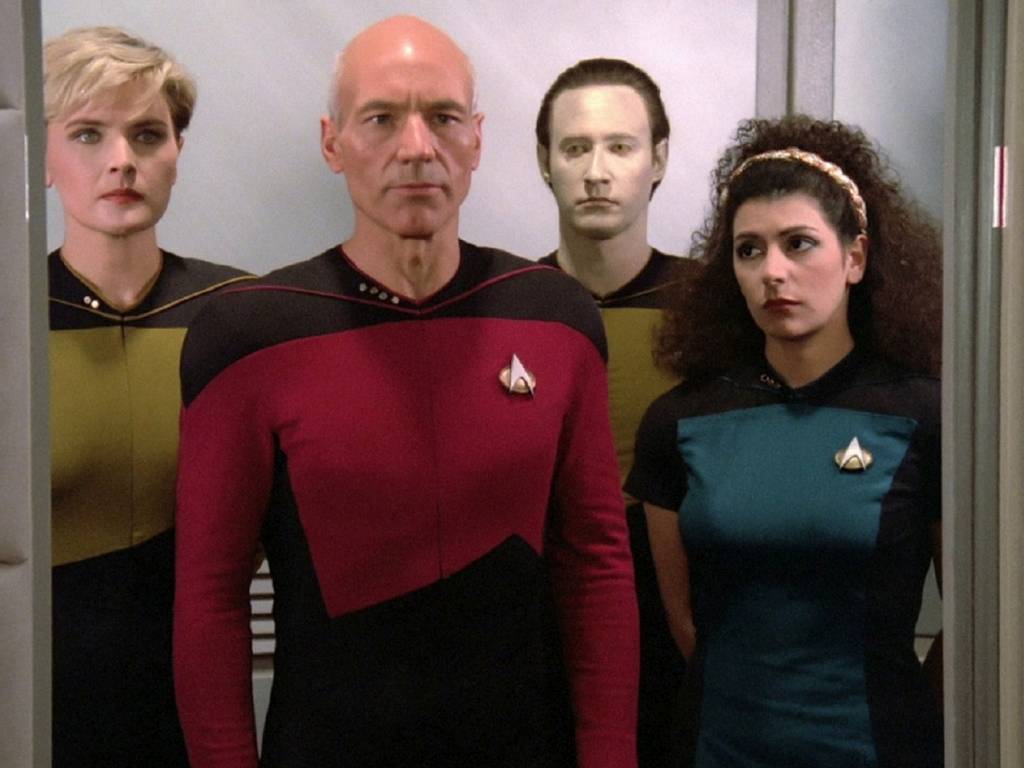
When The Next Generation premiered in 1987, William Ware Theiss returned to design the uniforms. He brought back the classic three-color system. However, there was one big twist. Red and gold switched places. Suddenly, command wore red while operations wore gold.
So Picard and Riker wore red as command officers. Meanwhile, Data, Geordi, and Worf eventually wore gold for operations, engineering, and security. Blue stayed with sciences, so Dr. Crusher kept her blue. Interestingly, Geordi and Worf started in red during season one before switching to gold.
So why did the Star Trek uniform colors flip? Canon has never explained it. Behind the scenes, the decision happened during pre-production of “Encounter at Farpoint.” A popular story claims Patrick Stewart felt he didn’t look commanding enough in gold. However, that’s never been firmly confirmed, so take it with a grain of Romulan salt.
There’s also a fun technical wrinkle. Brent Spiner’s gold makeup as Data blended better with a gold uniform. In red, his natural skin tone showed through more.
Either way, the swap stuck. These TNG Starfleet uniform colors became the standard for the next 15 years. Ironically, that means the redshirt curse technically applies to the captain now.
DS9, Voyager, and the Gray Shoulder Era

Once TNG locked in the new scheme, Star Trek uniform colors stayed remarkably stable. Deep Space Nine, Star Trek: Voyager, and all four TNG movies kept the same code. Red meant command, gold meant operations, and blue meant sciences. That’s a rare stretch of consistency for Starfleet’s notoriously indecisive tailors.
The cut, however, kept evolving. TNG’s early spandex jumpsuits were famously uncomfortable, so the show switched to wool tunics in season three. Later, TNG and DS9 moved the division color up to the shoulders over a darker base. Voyager adopted that same look for its entire run.
Next, Star Trek: First Contact shook things up again in 1996. The new uniforms were mostly dark gray and black. Division colors moved to an undershirt peeking out at the collar. DS9 adopted this darker look for its later seasons. Honestly, it fit the grim Dominion War tone perfectly.
Meanwhile, Picard occasionally wore a gray uniform with a red jacket on top. Think of it as Starfleet’s version of business casual.
Overall, this era proved the TNG Starfleet uniform colors could survive multiple redesigns. As long as command stayed red, fans knew exactly who was in charge.
Enterprise, Discovery, and Strange New Worlds

Whenever Star Trek travels back before TNG, the old Star Trek uniform colors come back too. Star Trek: Enterprise, set a century before Kirk, put its crew in NASA-style indigo jumpsuits. Department colors appeared as stripes on the shoulders. Since this was before the swap, Archer wore gold for command, while Trip and Reed wore red.
Then Star Trek: Discovery went shiny. Its 23rd-century uniforms were dark blue with metallic accents. Gold meant command, silver meant science, and bronze meant operations. It looked sleek and futuristic, even if it didn’t quite match TOS.
Next, Strange New Worlds leaned hard into nostalgia. The show stuck closest to the original 1966 designs and colors. Pike wears command gold, Spock wears blue, and Uhura wears red. Plus, both Discovery and SNW let medical officers wear all-white uniforms.
Meanwhile, the Star Trek (2009) reboot kept the classic gold, blue, and red with brighter, textured fabrics. Finally, Discovery’s jump to the 32nd century brought TNG-era gold back for engineer Jett Reno.
In short, Starfleet uniform colors follow the timeline. Go back, and command is gold. Go forward, and command is red.
Star Trek Uniform Colors by Era (Cheat Sheet)
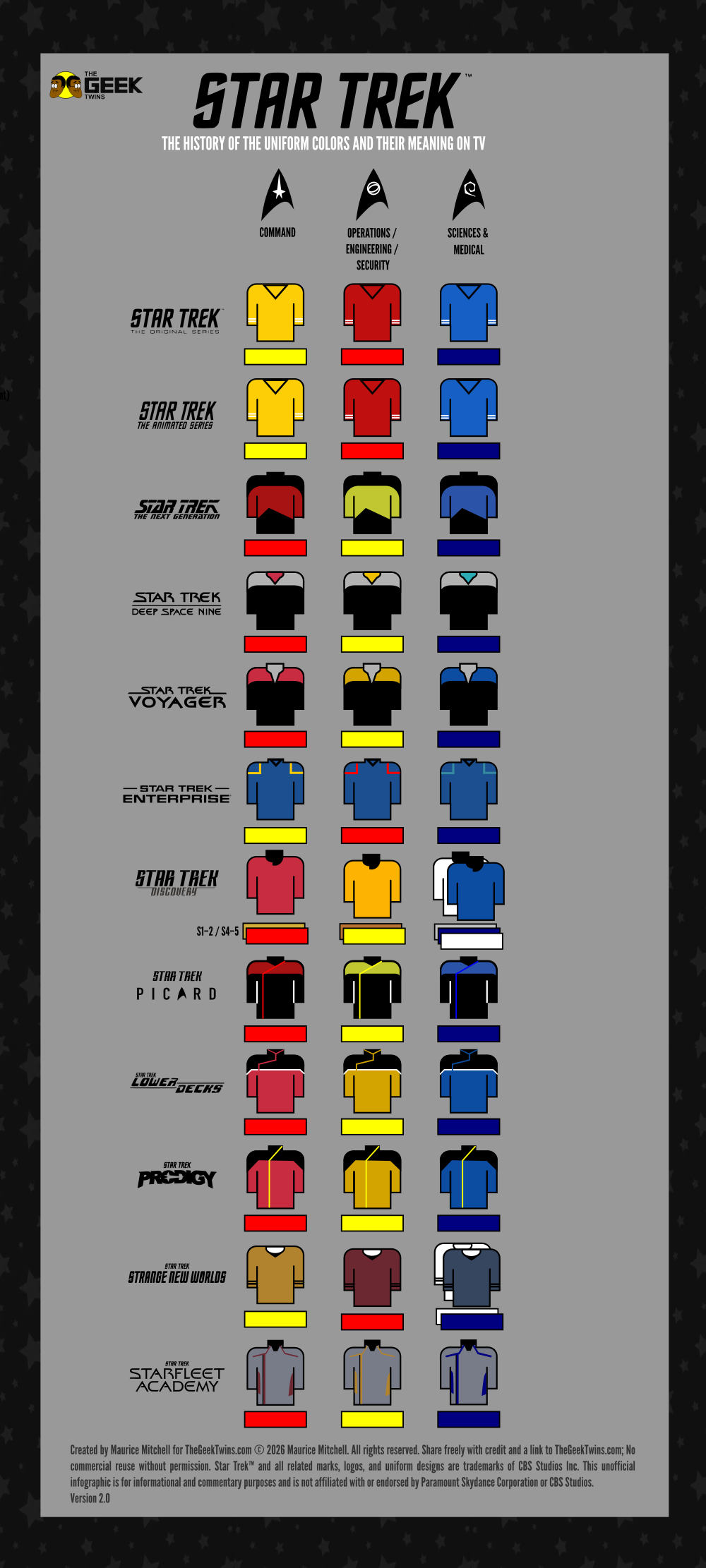
Need a quick reference for trivia night or your next convention? This cheat sheet breaks down Star Trek uniform colors by era. Even better, the infographic below shows every Starfleet division color in one glance. Bookmark it, screenshot it, or pin it. Either way, you’ll never confuse command gold with command red again.
Download the full chart by clicking the link here
| Era | Command | Sciences | Operations |
|---|---|---|---|
| Enterprise (2150s) | Gold | Blue | Red |
| Discovery (2250s) | Gold | Silver | Bronze |
| TOS / Strange New Worlds / Kelvin | Gold | Blue | Red |
| The Motion Picture | White | Orange | Gold / Red / Silver |
| Wrath of Khan to Undiscovered Country | White | Gray | Gold |
| TNG / DS9 / Voyager / Picard | Red | Blue | Gold |
| Discovery (32nd century) | Red | Blue | Gold |
Want to share this infographic on your own site? Go for it! Just copy the code below and credit The Geek Twins.
FAQ
What do the Star Trek uniform colors mean?
Star Trek uniform colors mark the three Starfleet divisions. Those are command, sciences, and operations, which cover engineering and security.
Why do red shirts die in Star Trek?
Security officers wore red and joined dangerous away missions. As a result, being in security was the real risk, not the shirt itself.
Was Captain Kirk’s uniform gold or green?
It was green. The velour photographed as gold under studio lights, and later shows made gold official.
Why did Star Trek switch red and gold in TNG?
The swap was a production choice made before “Encounter at Farpoint.” Canon has never explained it.
What color does a Starfleet doctor wear?
Doctors usually wear blue as part of sciences. However, Discovery and Strange New Worlds also allow all-white medical uniforms.
So there you have it. Starfleet uniform colors have shifted more than a Changeling at a costume party. Still, the core idea survives every redesign. Command, sciences, and operations each get their own hue. Kirk’s “gold” was green, Picard’s red meant power, and security officers everywhere should probably pick a new career. Whatever era you love, Star Trek uniform colors tell you exactly who’s running the show. And, sadly, who isn’t coming back from the away mission.
Which Star Trek uniform color would you wear, and would you risk the red?
Drop your pick in the comments. If this saved you from a trivia-night loss, share it with your crew on Facebook, X, and Pinterest. Live long and share often. 🖖
Discover more from The Geek Twins
Subscribe to get the latest posts sent to your email.